One of the biggest myths in business is that exit planning starts when you are ready to sell.
It does not.
By then, it may already be too late to fix the things that matter most.
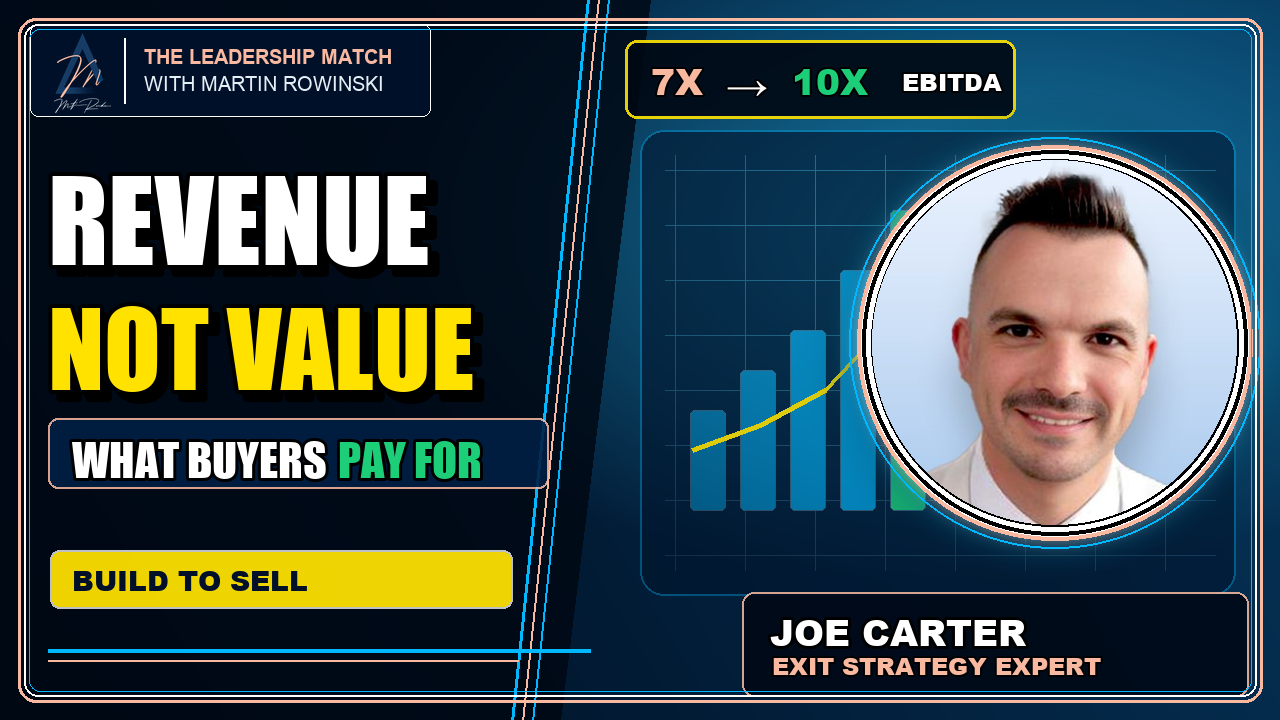
That was one of the key lessons from my conversation with Joe Carter on The Leadership Match. Joe is an entrepreneur, operator, exit strategy expert, and Co-Founder & COO of JWD Legacy Advisors. His story is powerful because he did not learn exit strategy from a textbook. He learned it by building, scaling, selling, and seeing firsthand what buyers actually value.
Joe started with one electronics repair shop and scaled into multiple locations. On the outside, the business looked strong. Revenue was growing. The company had traction. The exit was successful.
But during due diligence, Joe saw what many business owners do not see until a buyer starts pulling everything apart.
Revenue alone does not equal transferable value.
The business had gaps. Owner dependency. Documentation issues. Systems that were not as strong as they needed to be. Processes that lived too much in people’s heads instead of being clearly documented. Those gaps did not destroy the deal, but they impacted value.
That is a lesson every business owner needs to understand.
You can build a profitable company and still leave money on the table.
Revenue Is Not The Same As Value
A lot of business owners focus on revenue because revenue is easy to see.
More sales feel like progress. More customers feel like growth. A bigger top line feels like success.
And yes, revenue matters. But buyers look deeper.
They want to know if the business can run without the owner. They want to know if the leadership team is strong. They want to know if customer concentration creates risk. They want clean financials, documented systems, recurring processes, reliable reporting, and accountability inside the business.
In other words, buyers are not just buying what the business did yesterday. They are buying confidence in what the business can do tomorrow.
That is where value is created.
Joe made this point clearly. If every major decision still runs through the founder, that becomes a risk. If the company cannot function without the owner being involved in every detail, the buyer sees dependency. And dependency usually creates a discount.
Owner Dependency Quietly Reduces Value
This is one of the most important lessons for founders.
Many entrepreneurs are proud that they are the center of the business. They know the customers. They know the numbers. They solve the problems. They approve the decisions. They carry the relationships.
That may help in the early stages. But over time, it can become a ceiling.
If everything depends on you, the business is not as transferable as you think.
A buyer is going to ask a simple question: what happens when the owner leaves?
If the answer is uncertainty, that uncertainty has a cost.
This is where leadership matters. A strong business needs people, systems, and accountability that can carry the company forward without everything coming back to one person.
That is not just good for an eventual exit. It is good for the business today.
SOPs Are Value Builders
Joe talked about SOPs and documented processes as more than operational tools.
They are value builders.
That is a mindset shift.
A documented process is not just paperwork. It shows that the business can repeat what works. It makes training easier. It reduces confusion. It helps people execute consistently. It makes the company easier to scale and easier to transfer.
When a buyer looks at a business with clear systems, they see less risk.
When they see less risk, they are more likely to see stronger value.
This is where many owners need to take action before they ever think about selling. Start documenting what already happens inside the company. Sales process. Customer onboarding. Service delivery. Financial reporting. Hiring. Training. Follow-up. Quality control.
If the process matters, it should not live only in someone’s memory.
Weekly Accountability Creates Momentum
One of Joe’s strongest points was around accountability.
He is not talking about accountability as a boss pointing fingers and asking why something was not done. He is talking about a rhythm where people commit to specific actions, report progress, and understand how their work moves the business forward.
That matters.
Weekly accountability creates momentum because it keeps goals visible. It helps leaders see what is working and what is stuck. It creates ownership across the team. It also makes the company less dependent on the founder constantly pushing everything forward.
Joe’s framework centers on clear goals, measurable milestones, specific actions, and consistent follow-through.
That is simple, but simple does not mean easy.
A lot of companies have goals. Fewer have the weekly discipline to track action against those goals.
The companies that do create stronger execution.
Start With The Exit And Work Backward
One of Joe’s best pieces of advice was this: start with your exit and work backward.
That does not mean every owner has to sell. Your exit may mean selling to private equity. It may mean passing the business to the next generation. It may mean building a company that gives you more freedom and can operate without you. It may mean creating a stronger leadership team so the company is no longer dependent on your daily involvement.
The point is to define the outcome.
Once you know where you want to go, you can start building the business in that direction.
That is leadership.
You do not wait until the opportunity is on the table to start preparing. You build before you need it. You document before due diligence. You develop leaders before you are exhausted. You reduce risk before a buyer points it out. You create value before you ask the market to recognize it.
Final Thought
My conversation with Joe Carter was a reminder that a business should be more than a job with overhead.
It should become an asset.
That does not happen by accident. It happens through systems, leadership, accountability, documentation, financial clarity, and the discipline to build with the future in mind.
Revenue matters, but value is built deeper than revenue.
If you are a business owner, ask yourself this: if someone looked at your company today, would they see a business that can scale and operate without you, or would they see a business still dependent on you to hold everything together?
That question may be uncomfortable, but it is necessary.
Because the strongest businesses are not built the day the owner decides to sell. They are built long before that moment arrives.
Watch or read Joe Carter’s full The Leadership Match profile here: https://www.youtube.com/watch?v=j6zJLkYue_k
Read Joe Carter’s Profile: https://theleadershipmatch.com/guest-profiles/joe-carter