One of the reasons I created The Leadership Match is because I believe every leader has a story beyond the title.
The title tells us what someone does now. CEO. Founder. Partner. Board advisor. Chief Marketing Officer. Chief Operating Officer.
But the story behind the title tells us what shaped them.
That is where the real leadership lessons are found.
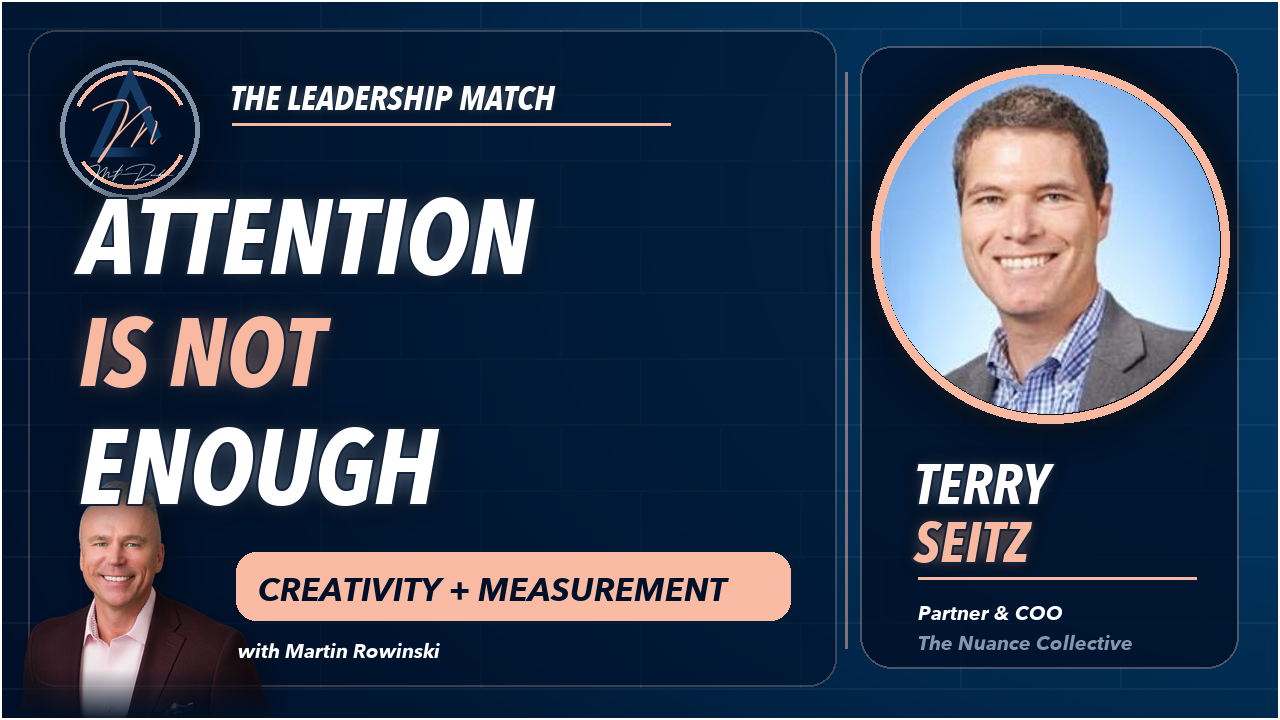
In my conversation with Terry Seitz, Partner and Chief Marketing & Operating Officer at The Nuance Collective, that story started in a very different place than most people might expect.
Before the marketing leadership roles, before the brand transformation work, before the board advisory experience, before working across major global platforms like Visa, the NFL, FIFA, the Olympics, ecommerce, digital wallets, and consumer marketing, Terry wanted to be an artist.
He admired painters like Jackson Pollock. He saw creativity as a real path. But like many people, he had to figure out how to take that passion and connect it to the real world of work, business, performance, and opportunity.
That part stood out to me.
Because leadership is often the same way.
Many leaders have something inside them before the title ever appears. A passion. A point of view. A way of seeing the world. A skill that does not look like business at first, but later becomes a real advantage.
For Terry, that creative foundation became part of how he approached advertising, marketing, strategy, operations, and growth.
And that is a powerful reminder for every executive and business leader: your past is not separate from your leadership. It is part of what gives your leadership depth.
Creativity Needs Direction
One of the big takeaways from my conversation with Terry is that creativity and business performance do not have to compete with each other.
Sometimes leaders separate the two.
They think creativity is for marketing teams, agencies, designers, or artists. Strategy is for executives. Numbers are for finance. Operations are for execution.
But the best leaders know these things have to work together.
Creativity without direction can become noise. Strategy without creativity can become stale. Measurement without story can become cold. Story without measurement can become disconnected from business results.
Terry’s view brings those pieces together.
He talked about the importance of a brief, a point of view, a topic, or a clear story. In other words, creativity works best when there is something to respond to. Constraints do not always limit creativity. Used the right way, they can unlock it.
That applies far beyond marketing.
In leadership, people perform better when they understand the mission. Teams create better ideas when they understand the problem. Executives make better decisions when values, vision, and mission are clear.
Creativity needs clarity.
Mistakes Can Open Better Paths
Terry also shared something that connected back to his early love of art.
When you are painting, especially in the style of artists like Pollock, you are not always operating inside perfect boxes. You are working with movement, mistakes, instinct, and discovery.
Leadership is not that different.
We like to pretend business is always linear. Step one, step two, step three, perfect result.
But anyone who has built anything knows that is not how it works.
Strategies shift. Markets change. People surprise you. Technology moves faster than expected. A campaign misses. A product does not land. A partnership falls apart. A decision that looked right at the time needs to be adjusted.
The leaders who grow are not the ones who never make mistakes. They are the ones who learn from them.
That is why nonlinear thinking matters.
Sometimes the mistake shows you a better path. Sometimes the problem reveals a new opportunity. Sometimes the thing that did not go according to plan becomes the reason you see something others missed.
But that only happens if leaders have enough perspective to pause, learn, and adjust instead of reacting from ego.
Attention Is Not Enough
This may be one of the most important leadership and marketing lessons from the episode.
We live in a world obsessed with attention.
Views. Clicks. Impressions. Viral moments. Big reactions. Short-term noise.
Attention matters, but attention by itself is not the goal.
Terry described attention as something that can become a false god if leaders and brands chase it without connecting it to enterprise value, trust, memory, or long-term growth.
I agree with that completely.
A leader can get attention and still not build trust. A brand can go viral and still not create loyalty. A company can make noise and still fail to communicate what it actually stands for.
The stronger work is consistency.
Showing up again and again with a clear message. Creating a real association in the mind of the market. Helping people understand who you are, what you do, what you value, and why it matters.
That is true for companies, and it is true for executives.
Your brand is not built in one big moment. It is built in small moments that repeat. It is built when your message, actions, decisions, relationships, and reputation all point in the same direction.
Marketing Teaches Leadership
Another part of the conversation I really appreciated was how Terry connected marketing principles directly to leadership.
Marketing is not just about campaigns. It is about storytelling. It is about frequency. It is about memory. It is about helping people understand and believe the message.
Leaders need the same discipline.
You cannot say something once and assume your team understands it. You cannot communicate vision one time and expect alignment forever. You cannot talk about values only when things are easy and expect people to trust them when things get hard.
People need to hear the message more than once.
Clear communication, repeated with purpose, creates alignment. It helps teams understand what matters. It helps people make better decisions when the leader is not in the room.
That is why strong leadership communication is not just about saying the right thing. It is about saying the right thing consistently enough that people can act on it.
Perspective Is A Leadership Advantage
When I asked Terry what leadership lesson he would match with every leader, his answer was perspective.
That is a strong answer.
Perspective helps leaders slow down when the world is moving fast. It helps them separate fact from emotion. It keeps them from chasing every shiny object. It helps them listen before reacting. It creates space for other points of view.
And in business, perspective can be the difference between smart growth and expensive distraction.
In the boardroom, perspective matters.
In marketing, perspective matters.
In leadership, perspective matters.
In times of change, perspective matters even more.
The best leaders are not just the ones who move fast. They are the ones who know when to move, why they are moving, and what decision best serves the mission.
Terry’s Action For Leaders
One of Terry’s most practical pieces of advice was simple:
Go to an AI tool and ask what it knows about your company, your brand, your product, and yourself.
What comes back may surprise you.
As AI continues to shape search, research, decision-making, purchasing behavior, and how people understand brands, leaders need to know what the market and the machines are playing back about them.
If the story is unclear, incomplete, or inaccurate, that is a signal.
It means your message may need work. Your public presence may need tightening. Your brand may not be communicating what you think it is communicating.
That is not something to ignore.
Because in today’s environment, people may form an opinion about you or your company before they ever speak with you.
Final Thought
Terry’s episode is a great reminder that leaders should not separate passion from performance.
Creativity matters. Strategy matters. Measurement matters. Discipline matters. But perspective is what helps connect all of it in a way that creates real growth.
The leader’s job is not just to chase attention. It is to create value.
It is to tell the story clearly.
It is to communicate consistently.
It is to learn from mistakes.
It is to bring creativity and discipline to the same table.
That is how leaders move beyond the title and create impact that lasts.
Watch or read Terry Seitz’s full The Leadership Match profile here: https://www.youtube.com/watch?v=QPBrjzjZM-Y
Read Terry Seitz’s Profile: https://theleadershipmatch.com/guest-profiles/terry-seitz