I see this all the time with leaders and companies.
They know the world is changing. They know their customers are moving faster. They know technology is forcing new decisions. They know their teams want more ownership, more clarity, and more purpose.
But they are still leading from an old playbook.
Everything has to go up the chain. Decisions take too long. Teams wait for permission. Leaders become bottlenecks. Innovation slows down, not because people do not have ideas, but because the organization is built to protect control instead of encourage progress.
That is where the shift from traditional leadership to agile leadership becomes so important.
And let me be clear: agile leadership is not about chaos. It is not about removing structure. It is not about letting everyone do whatever they want.
Agile leadership is about creating a structure where people can move faster, communicate better, learn continuously, and make decisions closer to the work without losing alignment around values, vision, and mission.
That is the real transition.
It is not just a process change. It is a leadership change.
The Problem With Traditional Leadership
Traditional leadership worked for a long time because business environments were more predictable. Leaders could build plans, assign responsibilities, create approval layers, and manage execution from the top down.
There is still value in structure. Every organization needs accountability, direction, and standards.
The problem starts when structure becomes too rigid.
When every decision has to be approved by the same small group of people, speed disappears. When employees are not trusted to make decisions, ownership disappears. When leaders believe their job is to have every answer, collaboration disappears.
Then companies wonder why their teams are not more innovative.
You cannot ask people to think like owners while treating them like order takers.
That is the leadership tension many organizations face today. They want agility, but they still reward control. They want innovation, but they punish mistakes. They want speed, but they build systems that slow everything down.
What Agile Leadership Really Means
Agile leadership is not just a methodology. It is a mindset.
It means leaders move from command and control to clarity and trust.
The agile leader does not disappear. The agile leader becomes even more important, but in a different way. Instead of controlling every decision, the leader defines the mission, sets the expectations, creates alignment, removes obstacles, and empowers the team to act.
That requires emotional maturity.
It requires leaders to put ego aside and admit, “I do not need to be the smartest person in every room. I need to make sure the right people are in the room.”
That is something I have believed for a long time. Strong leaders bring the right people to the table. Advisors, board members, executives, mentors, operators, and team members all bring perspective. The job of leadership is not to control every voice. It is to create the conditions where the best thinking can surface.
Agile leadership is built around a few important principles:
Clarity: People need to understand the goal, the why, and what success looks like.
Trust: Teams need enough authority to act without waiting for permission on every detail.
Communication: Leaders have to communicate openly, consistently, and to the point.
Adaptability: The organization must be willing to learn, adjust, and improve as conditions change.
Accountability: Agility does not remove accountability. It makes accountability more visible because teams own outcomes, not just tasks.
A Practical Case Study: TechAdapt
Let’s use a fictional company called TechAdapt.
TechAdapt was a mid-sized technology company with strong products, talented people, and a solid customer base. On paper, the company was doing well. But internally, the leadership team knew something was wrong.
Projects were taking too long.
Customer feedback was getting stuck in departments.
Employees were frustrated because they had ideas but no authority.
Leaders were overwhelmed because everything came back to them.
Competitors were moving faster.
The CEO started to realize the company did not have a talent problem. It had a leadership model problem.
The company was built for control, not speed.
So TechAdapt began the transition from traditional leadership to agile leadership.
Step One: Assess The Current Reality
The first step was not to throw a new system on top of an old culture. That is where many companies make the mistake.
They adopt agile terminology, create standups, rename teams, and think they have transformed. But nothing really changes because the mindset has not changed.
TechAdapt started with an honest assessment.
Where are decisions getting stuck?
Which teams are waiting for permission?
Where are customers giving feedback that leadership does not see quickly enough?
Which leaders are empowering people, and which leaders are unintentionally creating bottlenecks?
Where does fear of failure keep people from speaking up?
That assessment was uncomfortable. But truth is necessary for transformation.
You cannot fix what you are unwilling to face.
Step Two: Redefine The Role Of Leadership
The next step was helping senior leaders understand that agile leadership does not make them less important. It makes them more responsible for clarity.
Their role shifted from approving everything to aligning everyone.
That meant leaders had to answer important questions:
What is the mission?
What decisions can teams make without approval?
What decisions still require senior leadership involvement?
What does success look like?
What values should guide decisions when the answer is not obvious?
This is where values, vision, and mission become more than words on a wall.
In an agile environment, people need a strong foundation because they will be making more decisions. If the values are not clear, decisions will become inconsistent. If the vision is not clear, teams will move fast in different directions. If the mission is not clear, speed can turn into confusion.
Agility requires alignment.
Step Three: Start Small And Prove The Model
TechAdapt did not transform the entire company overnight.
They started with two pilot teams.
Each team was given a clear business outcome, a defined decision-making lane, and a regular feedback rhythm. Leaders stayed involved, but they did not micromanage. They asked better questions instead of giving constant instructions.
What are you learning?
What obstacle needs to be removed?
What customer feedback are you seeing?
What decision do you need to make?
How does this connect to the larger company goal?
That shift changed the energy.
Employees who had been waiting for approval started taking ownership. Managers who had been stuck in approval mode started coaching. Customers started seeing faster responses. Leadership started getting better information from the front lines.
That is what agile leadership can do when it is implemented with discipline.
Step Four: Build Feedback Loops
One of the biggest differences between traditional leadership and agile leadership is how feedback is treated.
In traditional environments, feedback often travels slowly and carefully. People polish it, soften it, or hide it because they do not want to create conflict.
In agile environments, feedback is treated as fuel.
TechAdapt created regular feedback loops between customers, teams, managers, and executives. Not long, complicated meetings. Short, focused check-ins built around learning and action.
What worked?
What did not work?
What did we learn?
What will we change next?
That rhythm helped the company make adjustments faster. It also made employees feel heard because their observations were being used to improve the business.
People support what they help build.
Step Five: Scale Without Losing Culture
Once the pilot teams showed progress, TechAdapt expanded the model across more departments.
But scaling required discipline.
This is where many companies lose their way. They confuse agility with speed alone. But speed without values creates problems. Speed without accountability creates confusion. Speed without communication creates silos.
TechAdapt focused on building a culture where agility meant responsible ownership.
Teams had more freedom, but they also had clear expectations. Leaders gave more trust, but they also expected transparency. Mistakes were not ignored, but they were used for learning instead of blame.
That balance is important.
Agile leadership does not mean lowering standards. It means giving people the trust, clarity, and support to meet higher standards.
The Results Of Agile Leadership
The benefits were not just operational. They were cultural.
TechAdapt became more responsive to customers. Projects moved faster because fewer decisions were stuck in approval chains. Employees became more engaged because they had more ownership. Leaders had more time to focus on strategy because they were no longer trapped in every detail.
The company also became more resilient.
That matters.
Agile organizations are better prepared for change because they are already practicing adaptation. They do not wait for a crisis to start communicating. They do not wait for the market to shift before they listen to customers. They do not wait for leadership to have every answer before they move.
They learn as they go.
Actionable Takeaways For Leaders
If your company is trying to move from traditional leadership to agile leadership, start here:
Assess your bottlenecks. Look honestly at where decisions slow down and where control is limiting progress.
Clarify decision rights. Make it clear what teams can decide, what leaders need to approve, and where collaboration is required.
Train leaders to coach, not just control. The best agile leaders ask better questions and remove obstacles.
Start with pilot teams. Prove the model in smaller areas before scaling it across the organization.
Create feedback loops. Make learning part of the operating rhythm.
Protect values, vision, and mission. Agility works best when everyone knows what the company stands for and where it is going.
Use technology wisely. Tools can support agile work, but technology does not replace leadership clarity.
Final Thought
The transition from traditional to agile leadership is not just about moving faster. It is about leading better.
It is about building organizations where people are trusted to think, communicate, decide, and act. It is about leaders letting go of unnecessary control without letting go of accountability. It is about creating a culture where change is not feared, but understood as part of growth.
The leaders who will thrive in the future are not the ones who hold every decision tightly.
They are the ones who build teams strong enough, aligned enough, and trusted enough to move forward with confidence.
That is agile leadership.
Not chaos. Not buzzwords. Not a new label on an old system.
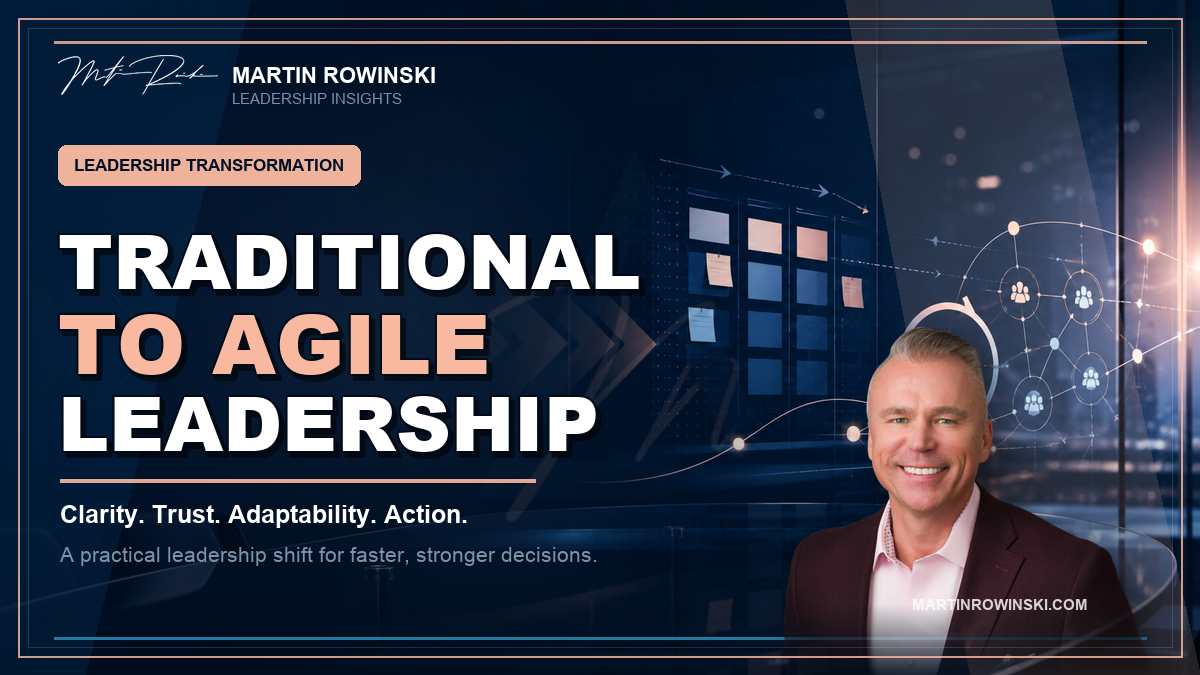
It is leadership built around clarity, trust, adaptability, communication, and action.