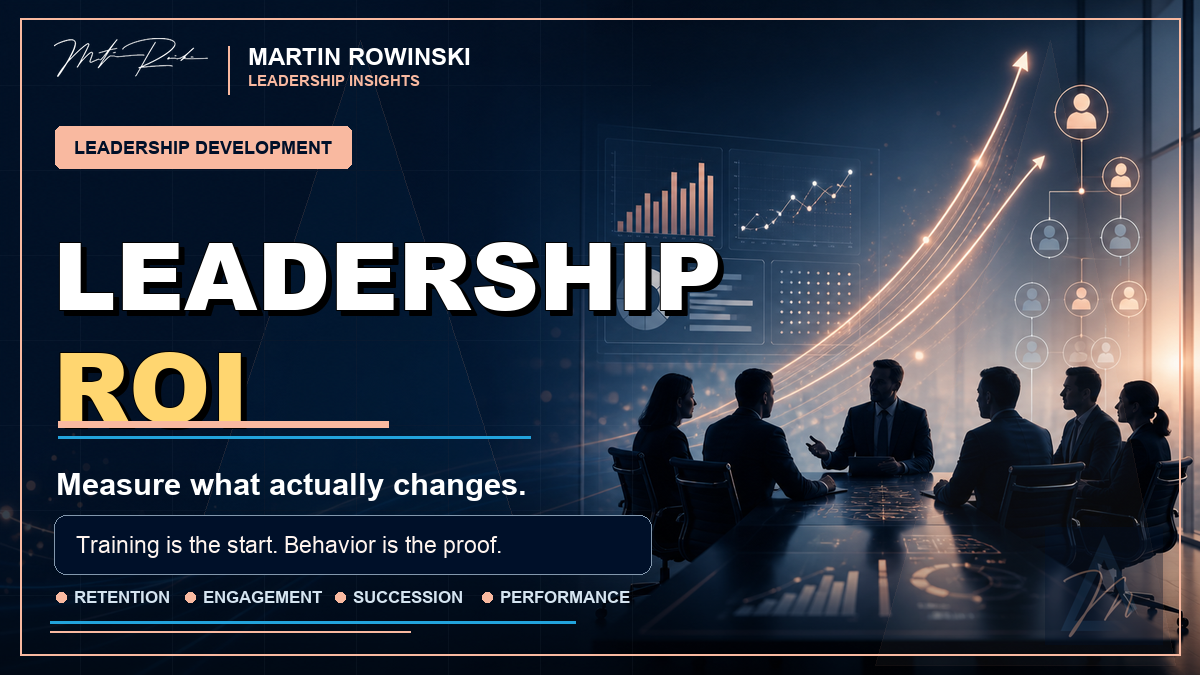
A leadership development program is not successful because people attended it.
It is not successful because everyone liked the speaker, enjoyed the workbook, or filled out a positive survey at the end of the day.
Those things matter, but they are not the real measurement.
The real question is this: did the program change behavior?
Did leaders communicate better? Did teams perform better? Did people stay longer? Did decision-making improve? Did the company build a stronger bench of future leaders?
That is where the real ROI of leadership development begins.
I believe leadership development is one of the most important investments a company can make, but only if it is tied to real business outcomes. Too many organizations treat leadership training like an event. They send people to a workshop, check the box, and hope something sticks.
Hope is not a strategy.
If leadership development is going to create value, it has to be connected to values, vision, mission, relationships, accountability, and action. It has to help leaders become better at leading people, solving problems, building trust, and moving the business forward.
Leadership Development Is A Business Investment
When a company invests in leadership development, it is really investing in the future of the organization.
A stronger leader can improve retention.
A stronger leader can develop talent.
A stronger leader can create clarity.
A stronger leader can reduce drama, confusion, and unnecessary turnover.
A stronger leader can help the company execute faster and make better decisions.
That is not soft. That is business.
The challenge is that leadership development can feel hard to measure because the results are not always immediate. You may not see the full return the next day or even the next month. Leadership growth compounds over time.
But that does not mean you cannot measure it.
You just have to measure the right things.
Start With The Outcome
Before you measure ROI, you have to define what success looks like.
That sounds simple, but many companies skip this step. They launch a leadership program before asking what problem the program is supposed to solve.
Are you trying to reduce turnover?
Prepare future executives?
Improve frontline management?
Strengthen succession planning?
Increase employee engagement?
Improve communication between departments?
Build a stronger culture of accountability?
Each of those goals requires different measurements.
If the goal is retention, then track retention.
If the goal is succession, then track readiness.
If the goal is better execution, then track project outcomes, decision speed, and team performance.
If the goal is culture, then track engagement, trust, communication, and employee feedback.
Leadership development should not live in a separate box outside the business. It should be connected directly to the business.
Metrics That Matter
Here are the measurements I would look at when evaluating the ROI of a leadership development program.
1. Leadership Retention
Are trained leaders staying with the company?
If leaders go through development and then leave, something is off. Maybe they did not feel supported. Maybe there was no path forward. Maybe the company developed them but did not give them room to use what they learned.
Retention is not only about keeping people. It is about keeping the right people and giving them a reason to keep growing.
2. Employee Engagement
One of the best ways to measure leadership is to look at the people being led.
Are employees more engaged?
Do they understand the mission?
Do they feel heard?
Do they trust their managers?
Do they see growth opportunities?
Are they willing to bring ideas forward?
A leadership program should improve the experience of the team, not just the confidence of the leader.
3. Performance And Productivity
Better leadership should show up in execution.
Teams should have more clarity. Projects should move with less confusion. Communication should improve. Priorities should be clearer. People should understand what success looks like and how their work connects to the bigger picture.
When leaders grow, the business should feel it.
4. Succession Planning
A strong leadership program should help answer an important question: who is ready for the next level?
Every company needs a leadership bench. If one key person leaves, retires, or moves into another role, does the company have people prepared to step up?
Succession is not built in an emergency. It is built through intentional development over time.
5. Behavior Change
This is one of the biggest pieces.
Did the leader actually change how they lead?
Are they listening better?
Are they delegating more effectively?
Are they giving clearer feedback?
Are they communicating with more transparency?
Are they building trust?
Are they handling pressure with more maturity?
You can measure this through 360 feedback, employee surveys, manager reviews, coaching notes, and real-world business outcomes.
The point is simple: do not just measure what leaders learned. Measure what they now do differently.
The Mistake Companies Make
The biggest mistake I see is measuring activity instead of impact.
How many people attended?
How many modules were completed?
How many hours of training were delivered?
Those are activity metrics. They tell you something happened, but they do not tell you whether it mattered.
The better question is: what changed because of it?
Leadership development should not be about checking a box. It should be about building stronger leaders who create stronger teams and stronger results.
A Practical Framework
If I were helping a company think through leadership development ROI, I would keep it simple.
First, define the business problem. Do not start with a program. Start with the leadership challenge the company needs to solve.
Second, set a baseline. Measure where you are today before training begins. Look at retention, engagement, performance, feedback, and succession readiness.
Third, connect learning to real work. Do not keep development theoretical. Give leaders real projects, real conversations, and real accountability.
Fourth, follow up. Leadership development does not happen in one session. Coaching, mentorship, feedback, and repetition are what help the learning stick.
Fifth, measure again. Look at what improved. Look at what did not. Adjust the program and keep going.
That is how development becomes a system instead of an event.
The Boardroom Perspective
From a board and executive leadership perspective, leadership development is also a risk management issue.
If the company does not have strong leaders, everything becomes harder.
Culture suffers.
Turnover increases.
Execution slows.
Communication breaks down.
Succession becomes reactive.
The organization becomes too dependent on a few people.
That is a risk.
Boards and CEOs should care about leadership development because it directly affects long-term value. A strong leadership pipeline makes the company more stable, more scalable, and more prepared for change.
So…
The ROI of leadership development is not just a number on a spreadsheet.
It is seen in the quality of decisions.
It is seen in the strength of the culture.
It is seen in the leaders who are ready before the opportunity arrives.
It is seen in employees who stay because they are growing.
It is seen in teams that trust each other and execute with clarity.
Leadership development works when it moves from training to transformation.
So before investing in the next program, ask yourself: what do we want our leaders to do better, and how will we know they are actually doing it?
That is where the real return begins.