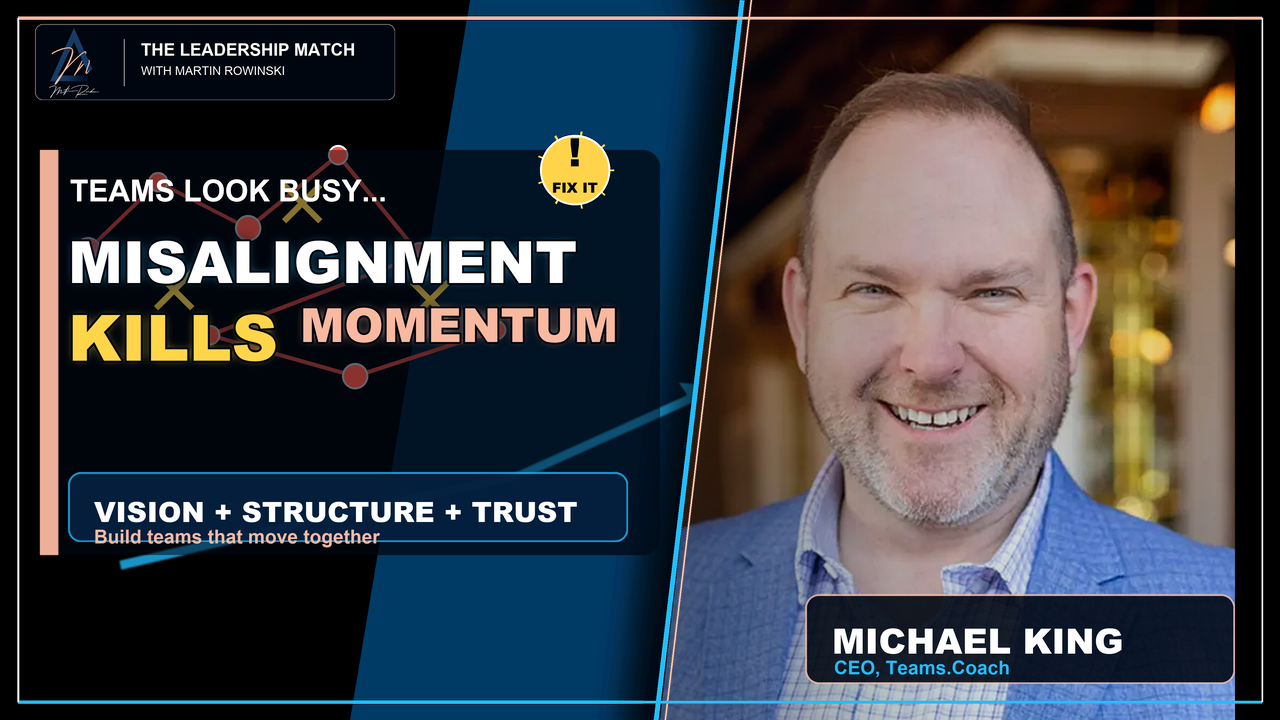
Michael King on Why Misalignment Is Killing Team Momentum
I had a great conversation with Michael King on The Leadership Match, and one of the biggest takeaways was simple:
Misalignment is expensive.
It does not always show up as one major problem. Most of the time, it shows up quietly. A team starts moving in different directions. Priorities become unclear. Communication slows down. People are working hard, but the work is not always connected to the same vision.
That is when momentum starts to disappear.
Michael King is the CEO of Teams.Coach, a certified executive coach, keynote speaker, and someone who spends his time helping leaders fix misalignment before it destroys momentum. His work focuses on building healthy, fun, collaborative, and trusting team cultures.
That is why this conversation mattered.
Because leadership is not just about having a vision. It is about making sure that vision is active, understood, and lived inside the organization.
Vision Has To Be Active
A lot of companies have a vision statement.
It is on the website. It is in the employee handbook. It might even be framed on the wall.
But that does not mean the team is aligned around it.
Michael made a strong point during our conversation: vision should be an active, living part of the organization. No one on the team should have to guess what the vision is.
That hit me because I have seen this many times in business. Leaders assume people understand the mission, but they have not communicated it clearly enough or often enough. Then they wonder why execution feels scattered.
If the vision is not clear, people will create their own version of what matters.
That is where misalignment begins.
Systems Create Scale
Another point Michael made was that structure is the gateway to effective strategy, and systems are the gateway to effective scale.
I agree with that.
A lot of leaders want growth, but they do not always build the systems that make growth sustainable. They want the team to move faster, but the process is unclear. They want accountability, but expectations are not defined. They want better performance, but the organization is still relying on personality instead of structure.
Strong teams need more than motivation.
They need systems that help people know what matters, how decisions get made, how communication flows, and how accountability works.
And those systems cannot be static. Business is moving too fast. Teams have to adapt in real time.
Fun Is Not A Distraction From Performance
One of my favorite parts of the conversation was when we talked about fun.
A lot of leaders still treat fun like something separate from performance. Something extra. Something nice to have after the serious work is done.
Michael challenged that idea.
He said creativity does not flourish without fun. That does not mean lowering standards or avoiding accountability. It means creating a culture where people feel safe enough to contribute, collaborate, take risks, and bring ideas forward.
People remember how you make them feel.
That matters in leadership.
If people feel pressured, unheard, or disconnected, they may still show up physically, but they will not bring their best thinking. If they feel trusted, challenged, respected, and connected to the mission, they are much more likely to perform at a higher level.
Fun, trust, and psychological safety are not soft ideas.
They are part of how strong teams work.
Build Your Team By Design
Michael also talked about building teams by design.
That means being intentional about who you bring into the organization and who you allow to carry the vision forward.
Leadership is not about trying to do everything yourself. It is about creating more leaders around you. It is about replicating the values, behaviors, character, competency, chemistry, and vision that help the organization grow.
That is how leaders open up bandwidth.
That is how companies scale.
When the right people understand the vision, own the mission, and operate with the right systems, the leader does not become the bottleneck. The team becomes stronger.
My Takeaway
The biggest lesson from this episode is that alignment does not happen by accident.
You have to build it.
You build it through clear communication.
You build it through active vision.
You build it through systems.
You build it through trust.
You build it through culture.
You build it through the people you bring to the table.
Misalignment eats momentum. But alignment creates movement.
And when a team is aligned, it can move faster, make better decisions, and create stronger results.
That is leadership.
Watch the full episode of The Leadership Match with Michael King here: https://www.youtube.com/watch?v=5D8ghfB9KFY
Check out his profile: https://theleadershipmatch.com/guest-profiles/michael-king