One of the most dangerous things that can happen inside an executive team is not conflict.
It is sameness.
Same background. Same point of view. Same assumptions. Same way of solving problems. Same comfort with risk. Same blind spots.
At first, that kind of sameness can feel efficient. Meetings move faster. People agree quickly. Decisions feel easier. There is less friction in the room.
But here is the problem: agreement is not always alignment. Speed is not always wisdom. A quiet room is not always a healthy room.
Sometimes a team is not aligned. They are just thinking in circles.
That is why cognitive diversity matters so much in executive leadership.
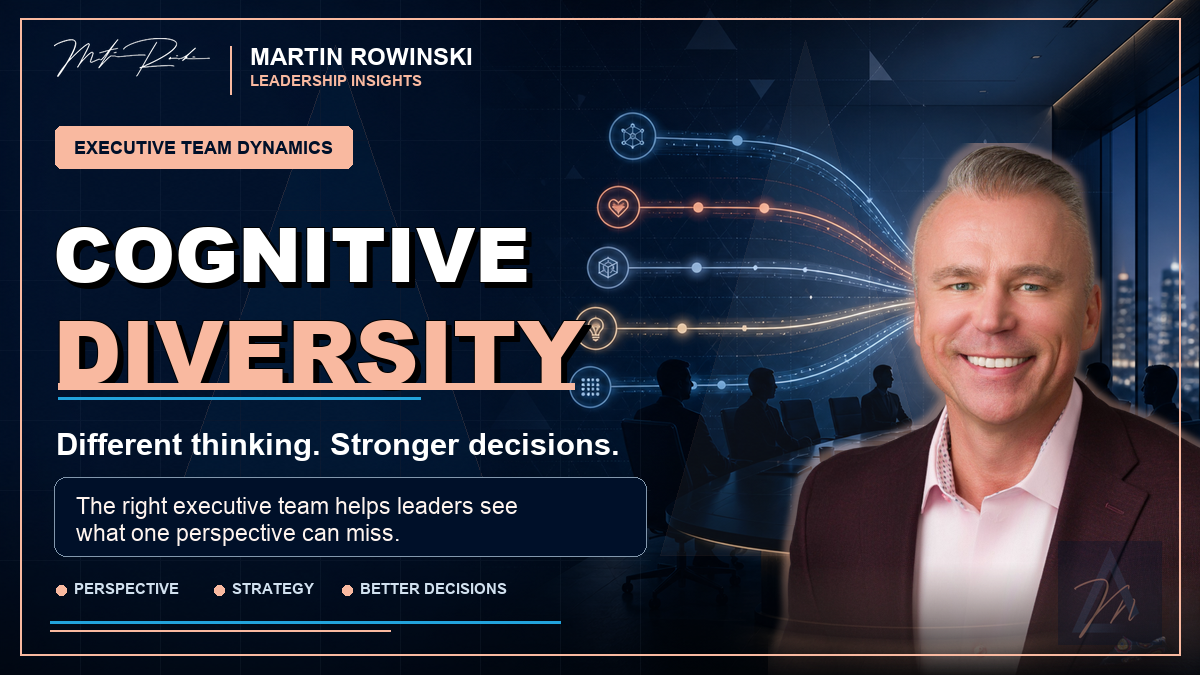
Cognitive diversity is not just about demographics, job titles, education, or professional experience. Those things matter, but cognitive diversity goes deeper. It is about how people think, how they process information, how they solve problems, how they challenge assumptions, how they see risk, and how they connect dots others may miss.
For executive teams and boards, this is not a nice-to-have. It is a strategic advantage.
What Cognitive Diversity Really Means
Cognitive diversity is the difference in thinking styles inside a team.
One leader may naturally think in numbers.
Another may think in people and culture.
Another may see operational risk.
Another may see market opportunity.
Another may understand technology.
Another may challenge the customer experience.
Another may ask, “What are we not seeing?”
That mix matters.
The strongest executive teams are not built by putting the same type of leader around the table over and over again. They are built by bringing together leaders who can challenge, sharpen, and expand each other’s thinking.
That is what I believe a great board should do too. A great board is not ceremonial. It is a mastermind group. It brings perspective, accountability, credibility, discipline, and wisdom. It helps the CEO and leadership team see what they cannot see alone.
The same principle applies to executive team dynamics.
If everyone thinks the same way, you may move quickly, but you may also miss the risk sitting right in front of you.
Why Executive Teams Need Different Thinking
Today’s business environment is not simple.
Leaders are dealing with AI, talent shifts, market volatility, customer expectations, cybersecurity risk, global complexity, capital pressure, brand reputation, and constant change.
No single executive has the full answer.
That is why the right team matters.
Cognitive diversity helps executive teams make better decisions because it forces the room to look at problems from more than one angle. It helps leaders avoid groupthink. It strengthens problem-solving. It creates more thoughtful debate. It helps teams prepare for disruption instead of being surprised by it.
When cognitive diversity is working, the conversation changes.
Instead of asking only, “Can we do this?”
The team also asks:
Should we do this?
What could go wrong?
Who does this impact?
What does the customer need?
What does the data show?
What are we assuming?
What happens if the market shifts?
What would the board ask us?
What decision best aligns with our values, vision, and mission?
Those questions create stronger leadership.
Cognitive Diversity Is Not Conflict For The Sake Of Conflict
Let me be clear.
Cognitive diversity does not mean creating arguments in every meeting. It does not mean bringing people into the room just to disagree. It does not mean turning every decision into a long debate.
It means building a team where different perspectives are respected enough to be heard before the decision is made.
There is a difference between healthy challenge and destructive conflict.
Healthy challenge is about making the decision better.
Destructive conflict is about ego, politics, or control.
Strong leaders know how to create space for honest discussion without letting the room become divided. That requires trust. It requires emotional intelligence. It requires communication that is truthful, transparent, and to the point.
If people do not feel safe speaking up, cognitive diversity will not matter because the different thinking will stay silent.
And silent diversity does not create better decisions.
The Role Of The CEO And Senior Leader
If you are the CEO or senior leader, cognitive diversity starts with you.
You have to decide whether you want people who simply agree with you or people who help you think better.
That is not always easy.
It takes humility to invite a different point of view. It takes maturity to listen when someone challenges your idea. It takes confidence to bring people into the room who may see something you missed.
But that is leadership.
I have always believed leaders do not have to build alone. Asking for help is not weakness. Bringing the right people to the table is wisdom.
The CEO’s job is not to be the smartest voice in every room. The CEO’s job is to make sure the right voices are in the room, the mission is clear, and the best thinking is being used to move the company forward.
How To Build Cognitive Diversity Into The Executive Team
Cognitive diversity does not happen by accident. Leaders have to build it intentionally.
Start with the team you already have.
Ask yourself:
Do we have too many people who think the same way?
Where are our blind spots?
Who challenges our assumptions?
Who understands the customer differently?
Who sees risk earlier?
Who brings operational discipline?
Who brings innovation?
Who brings financial clarity?
Who brings people and culture perspective?
Who is missing from the conversation?
That kind of audit can be very revealing.
Then look at how decisions are made. If the same two or three voices dominate every meeting, you may have cognitive diversity on paper but not in practice. If people are afraid to challenge the leader, you do not have a thinking problem. You have a trust problem.
Next, look at recruitment.
When hiring executives or building advisory and board relationships, do not only look for familiar profiles. Look for complementary thinking. Look for people who bring a different lens but still align with the company’s values, vision, and mission.
The goal is not to create a team of opposites. The goal is to create a team that is aligned in purpose but diverse in perspective.
The Role Of Onboarding And Culture
Hiring different thinkers is only the first step.
The real work is integrating them.
If a company brings in a leader with a different perspective but then expects that person to conform immediately to the old way of thinking, the value is lost.
Onboarding should help leaders understand the business, but it should also invite them to share what they see. Sometimes the newest person in the room can identify patterns that everyone else has stopped noticing.
Culture matters here.
A strong culture does not silence differences. It gives them a productive place to live. It creates standards for communication, debate, feedback, accountability, and decision-making.
That is how cognitive diversity becomes useful instead of chaotic.
Technology Can Help, But It Cannot Replace Judgment
AI and data analytics can help leaders understand team dynamics, communication patterns, skills, and decision-making tendencies. These tools can be useful when applied carefully.
But technology should not become a shortcut for human judgment.
You cannot reduce leadership to a dashboard. You cannot understand every executive’s value through a personality test. You cannot build a great team through data alone.
Technology can reveal patterns. Leaders still have to build trust, ask better questions, listen carefully, and create the environment where different thinking actually improves decisions.
The Challenges Are Real
Cognitive diversity can be uncomfortable.
Different thinking can slow down a conversation at first. It can reveal tension. It can challenge long-held assumptions. It can make leaders defend ideas more clearly.
That is not a bad thing.
The discomfort is often where growth begins.
The key is to create a shared commitment around the mission. When everyone understands the purpose, the values, and the desired outcome, different perspectives become a strength instead of a threat.
That is why values, vision, and mission matter so much. They give the team a common foundation even when the thinking styles are different.
To wrap this up…
Cognitive diversity should not be treated as an HR metric.
It is a leadership asset.
It helps executive teams see more clearly, challenge assumptions, make better decisions, innovate with more discipline, and build resilience when the market changes.
The future will not reward executive teams that all think the same way. It will reward teams that can bring different perspectives together and turn that difference into better action.
So here is my challenge:
Look around your leadership table.
Are you surrounded by people who make you comfortable, or people who make the company better?
The right executive team does not just agree faster. It thinks deeper, sees wider, and leads stronger.
That is the power of cognitive diversity.
#ExecutiveLeadership #CognitiveDiversity #LeadershipDevelopment #TeamDynamics #BoardLeadership #StrategicThinking #Innovation