Innovation does not start with a slogan. It starts with the people in the room.
I have seen companies talk about innovation while keeping the same decision-making habits, the same narrow viewpoints, and the same fear of failure that prevented innovation in the first place. That is where many leadership teams get stuck. They want new ideas, but they have not created the environment where new ideas can survive.
Senior management sets the tone for the entire organization. If the executive team is curious, open, disciplined, and willing to challenge old assumptions, that energy moves through the company. If the executive team is defensive, slow, political, or afraid to take a calculated risk, that energy moves through the company too.
Innovation among senior leaders is not just about products, technology, or market expansion. It is about mindset. It is about how leaders think, how they listen, how they make decisions, how they use data, how they invite different perspectives, and how they respond when something does not work.
If you want innovation to grow, you have to build the right conditions for it.
Start With Diversity Of Thought
One of the strongest ways to unlock innovation is to bring different perspectives to the table.
I talk a lot about boards, advisors, and executive teams because the room matters. The people around the table shape the questions being asked. They shape what risks are noticed. They shape what opportunities are pursued. They shape whether a company keeps repeating the past or starts seeing a better future.
Diversity of thought is not a checkbox. It is a business advantage.
When senior leaders come from different backgrounds, industries, functions, generations, and life experiences, they see problems differently. A finance leader may see risk. A sales leader may see market timing. A technology leader may see scalability. A people leader may see culture. A board member or advisor may see patterns from another industry entirely.
The goal is not to create disagreement for the sake of disagreement. The goal is to build a leadership room where ideas are tested from multiple angles before the company commits time, money, and people.
If everyone thinks the same way, innovation becomes limited before the conversation even starts.
Create Space For Ideas To Move
Rigid leadership structures can slow innovation down.
I am not saying companies should abandon process. Process matters. Accountability matters. But when every idea has to travel through too many layers, too many approvals, and too much internal politics, the best ideas often lose momentum.
Senior management teams need clear ways for ideas to move.
That might mean creating small cross-functional groups to test new concepts. It might mean giving leaders permission to pilot an idea before building a full business case. It might mean using advisory boards or outside experts to pressure-test assumptions. It might mean setting aside time in leadership meetings for strategic possibilities, not just operational updates.
Innovation needs structure, but it also needs room to breathe.
A strong leadership team should know the difference between reckless speed and healthy momentum. Reckless speed ignores risk. Healthy momentum removes unnecessary friction so good ideas can be explored before the opportunity passes.
Encourage Calculated Risk
Innovation always carries risk. The question is whether the risk is thoughtful or careless.
Many senior leaders avoid innovation because they do not want to be associated with failure. That is understandable, but it is also dangerous. If leaders only protect what already exists, the company can become comfortable while the market moves on.
I believe in calculated risk. That means leaders should ask hard questions:
- What problem are we solving?
- What customer, market, or operational need does this address?
- What are we willing to test before we scale?
- What resources are required?
- What could go wrong?
- How will we know whether the idea is working?
When leaders define the risk clearly, they can move with more confidence. They do not have to bet the company on every idea. They can test, learn, adjust, and scale what works.
Failure should not be celebrated blindly. But learning should be. If a team runs a thoughtful experiment, gathers real information, and improves the next decision, that is not wasted effort. That is leadership development.
Give Leaders The Right Tools And Resources
You cannot ask senior leaders to innovate and then deny them the tools, data, talent, and authority required to do it.
Innovation needs resources. Sometimes that means technology. Sometimes it means training. Sometimes it means better data. Sometimes it means access to outside advisors, board members, or industry experts who can bring a fresh point of view.
Senior leaders also need time. If every executive is buried in urgent operational work, innovation will always be pushed to the side. The company may say innovation is a priority, but the calendar will tell the truth.
Leaders need space to think strategically. They need room to study trends, understand customer behavior, evaluate competitors, and look beyond the immediate quarter. That kind of thinking does not happen when every meeting is reactive.
Innovation is not a side project. It has to be supported like a real business priority.
Measure What Matters
If innovation is important, it needs to be measured. But leaders have to be careful about what they measure.
Counting ideas is not enough. A company can generate hundreds of ideas and still make very little progress. The better question is: which ideas are creating value?
Useful innovation metrics may include:
- New initiatives tested
- Speed from idea to pilot
- Customer or employee feedback
- Process improvements
- Revenue or margin impact
- Cost savings
- Adoption rates
- Lessons learned from experiments
The point is not to turn creativity into bureaucracy. The point is to make innovation visible. When senior leaders can see what is being tested, what is working, and what needs to change, they can make better decisions.
Innovation should have accountability. Otherwise, it becomes a word people use in meetings without changing anything in the business.
Keep Learning At The Executive Level
Senior leaders cannot lead innovation if they stop learning.
Markets change. Technology changes. Customers change. Talent expectations change. Board expectations change. The leaders who stay curious are the leaders who keep seeing opportunity before others do.
Continuous learning should be part of senior management culture. That includes reading, listening, attending industry events, meeting with advisors, studying competitors, and having honest conversations with customers and employees.
The best leaders I have worked with are not the ones who pretend to know everything. They are the ones who ask better questions. They are willing to be challenged. They put ego aside long enough to learn.
That is where innovation begins.
Build A Room Where People Can Challenge Each Other
Innovation requires trust.
If senior leaders are afraid to speak honestly, the company will miss opportunities. If people only say what the CEO wants to hear, the leadership team becomes weaker. If every new idea is criticized before it is understood, people stop bringing ideas forward.
The best leadership rooms allow respectful challenge. People can disagree without making it personal. They can question assumptions without attacking each other. They can debate the strategy and still leave aligned around the decision.
This is where a strong board, advisory board, or executive team can add real value. The right people at the table help connect the dots. They bring perspective. They ask questions the internal team may not be asking. They help leaders see what is possible and what may be missing.
Innovation is not a solo act. It is built through the right conversations with the right people.
Final Thought
Fostering innovation among senior management teams is not about telling leaders to “be more creative.” It is about building the structure, trust, diversity, accountability, and momentum that allow creativity to become business value.
Senior leaders have to model the behavior they want from the organization. They have to listen, learn, challenge assumptions, take calculated risks, and stay connected to values, vision, and mission.
If the leadership team is willing to grow, the company has a much better chance to grow with it.
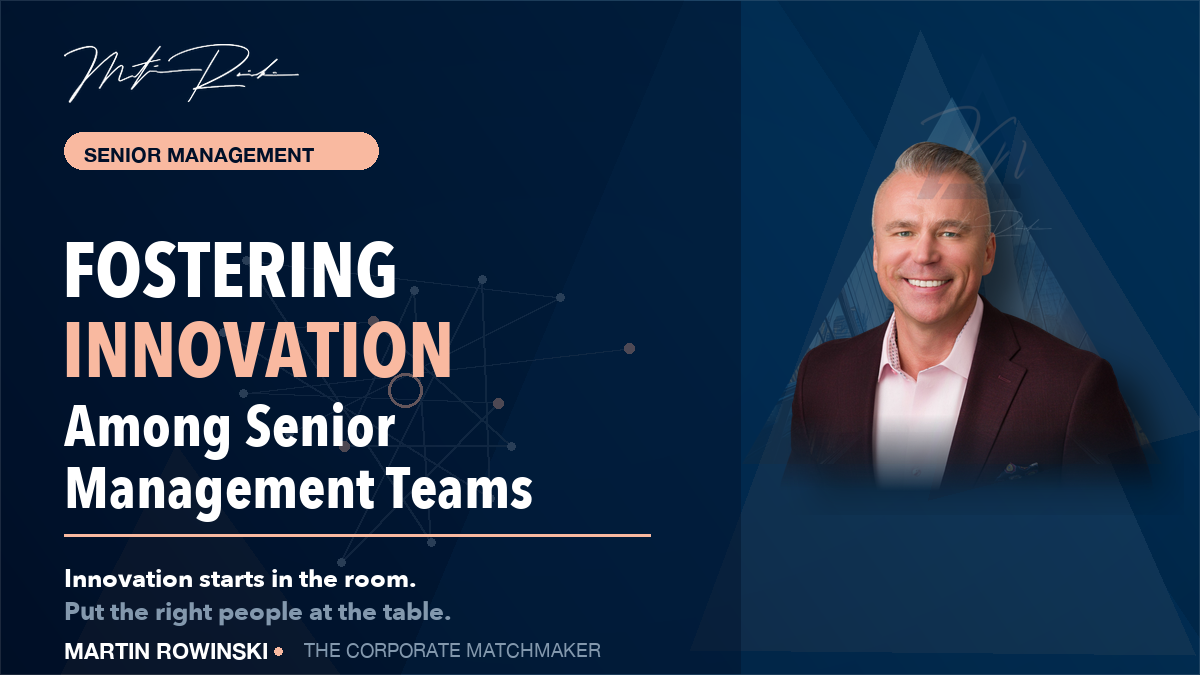
Innovation starts in the room. Make sure you have the right people at the table.
Meta Description
#Innovation #Leadership #ExecutiveLeadership #Management #BusinessStrategy #SeniorManagement #BoardLeadership
Martin Rowinski shares first-person leadership strategies for fostering innovation among senior management teams through diversity of thought, calculated risk, accountability, learning, and the right people at the table.