
The landscape of executive recruitment is undergoing a seismic shift, driven by the rapid advancements in artificial intelligence (AI). As organizations strive to identify and secure top-tier talent, AI offers unprecedented capabilities in streamlining and enhancing the recruitment process. However, while AI brings remarkable efficiencies, the human touch remains indispensable.
“AI can analyze data, but only humans can understand the heart and soul of a candidate.”
Martin Rowinski
The Role of AI in Executive Recruitment
AI is revolutionizing executive recruitment in several key ways:
Data-Driven Decision Making: AI algorithms can analyze vast amounts of data to identify patterns and predict candidate success. This data-driven approach allows recruiters to make more informed decisions, reducing the risk of hiring mismatches.
Enhanced Candidate Sourcing: AI-powered tools can scour the internet, social media, and professional networks to identify potential candidates who may not be actively seeking new opportunities. This expands the talent pool and uncovers hidden gems.
Automated Screening: AI can automate the initial screening process, quickly filtering out unqualified candidates and highlighting those who meet the desired criteria. This saves recruiters valuable time and ensures a more efficient process.
Predictive Analytics: By analyzing historical hiring data, AI can predict which candidates are likely to succeed in specific roles. This predictive capability helps organizations make more strategic hiring decisions.
The Indispensable Human Touch
While AI offers significant advantages, it cannot replace the nuanced expertise and emotional intelligence that human recruiters bring to the table. Here’s why the human touch remains crucial:
Understanding Cultural Fit: AI can assess skills and experience, but it cannot gauge a candidate’s cultural fit within an organization. Human recruiters excel at understanding the subtleties of organizational culture and how a candidate will integrate into the team.
Building Relationships: Executive recruitment is as much about building relationships as it is about finding the right skills. Human recruiters can establish trust and rapport with candidates, providing a personalized experience that AI cannot replicate.
Assessing Soft Skills: Soft skills such as leadership, communication, and emotional intelligence are critical for executive roles. Human recruiters are adept at evaluating these intangible qualities through interviews and interactions.
Ethical Considerations: AI algorithms can inadvertently introduce biases if not carefully managed. Human oversight ensures that ethical considerations are taken into account, promoting diversity and inclusion in the recruitment process.
Balancing AI and Human Insight
The future of executive recruitment lies in striking the right balance between AI and human insight. Here are some strategies to achieve this balance:
Integrate AI as a Tool, Not a Replacement: Use AI to enhance the recruitment process, not to replace human recruiters. AI can handle repetitive tasks and data analysis, freeing up recruiters to focus on high-value activities.
Continuous Learning and Adaptation: Both AI and human recruiters should engage in continuous learning. AI algorithms should be regularly updated to reflect changing market conditions, while recruiters should stay informed about the latest technological advancements.
Collaborative Decision Making: Encourage collaboration between AI systems and human recruiters. AI can provide data-driven insights, while human recruiters can interpret these insights within the context of the organization’s unique needs.
Ethical AI Practices: Implement ethical AI practices to ensure fairness and transparency. Regularly audit AI algorithms for biases and involve diverse teams in the development and oversight of AI systems.
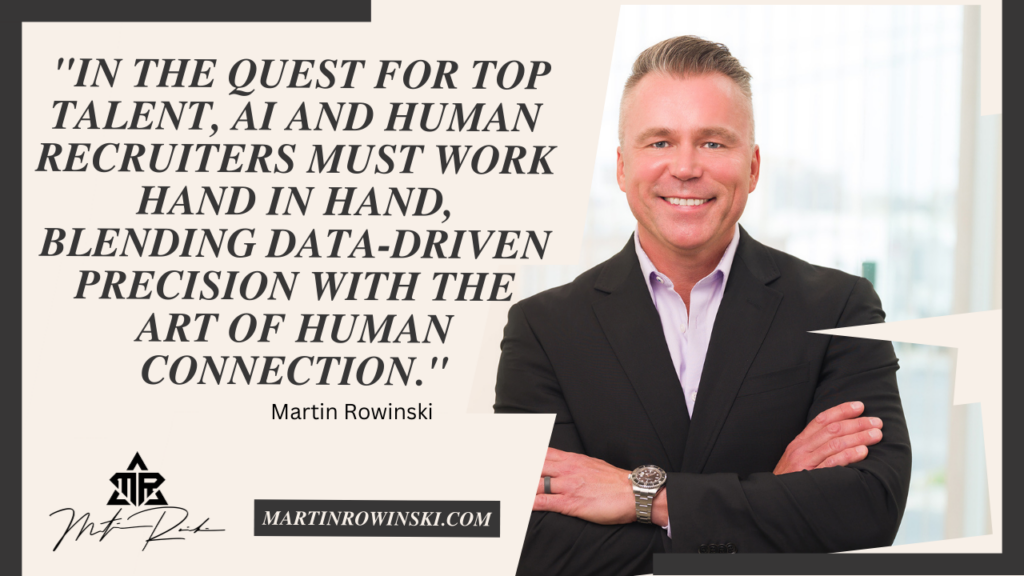
“In the quest for top talent, AI and human recruiters must work hand in hand, blending data-driven precision with the art of human connection.”
Martin Rowinski
 AI is undeniably transforming the landscape of executive recruitment, offering powerful tools to identify and secure top talent. However, the human touch remains irreplaceable, providing the emotional intelligence, cultural understanding, and ethical oversight that AI lacks. By harnessing the strengths of both AI and human insight, organizations can navigate the complexities of talent acquisition and build high-performing executive teams for the future.