
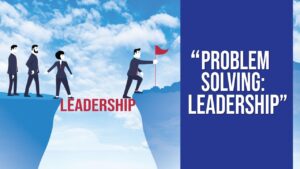
Leadership is an essential element of every prosperous firm. An essential characteristic of an exceptional leader is their adeptness in efficiently resolving challenges. An effective leader possesses exceptional problem-solving abilities, enabling them to accurately identify and thoroughly analyze issues, produce a range of alternative solutions, and make well-informed judgments that result in favorable outcomes.
 The foundation of effective issue-solving lies in the capacity to recognize and articulate the problem. A leader must possess the ability to collect and evaluate information, and subsequently express the problem in a clear and concise manner to their team. This stage is crucial, as it establishes the basis for the subsequent problem-solving process.
After identifying the problem, a leader must generate possible solutions. This necessitates the use of ingenuity and analytical reasoning, together with the capacity to contemplate other viewpoints and alternatives. It is important for a leader to engage their team in this process, as including a range of opinions and ideas can result in more efficient solutions.
Once possible solutions have been created, a leader must assess and choose the most optimal path of action. This necessitates the capacity to evaluate the advantages and disadvantages of each alternative and reach a conclusion based on the accessible information. In addition, a leader must possess the ability to foresee possible challenges and formulate strategies to surmount them.
Ultimately, a leader must implement the selected solution and closely evaluate its efficacy. This necessitates the capacity to effectively communicate and collaborate with team members, along with the capability to adapt and modify as necessary.
Enhancing your Problem-Solving Abilities
- Engage in active listening: When attempting to resolve a problem, it is crucial to actively listen to others and genuinely comprehend their viewpoints. Through the practice of attentive listening and active participation, you will enhance your ability to discern and comprehend the underlying source of an issue.
- Gain knowledge from your errors: Defeat is an unavoidable component of resolving problems. Rather than becoming disheartened, utilize your errors as chances to acquire knowledge and enhance your abilities. Contemplate the factors that led to the failure and consider alternative actions you could have taken.
- Maintain a systematic approach: Maintain a comprehensive record of all relevant data pertaining to a problem and its possible resolutions. Structuring your thoughts and organizing your facts will facilitate the identification of connections and patterns that may not be readily apparent.
- Cultivate a broad and varied outlook: Examine issues from several perspectives and endeavor to comprehend how they may be perceived by others. This will assist you in generating a greater number of innovative and efficient solutions.
- Maintain composure in high-stress situations: Problem-solving frequently necessitates rapid cognitive processing and decisive action. Maintaining composure and concentration is crucial, particularly when confronted with challenging or stressful circumstances.
- Gain knowledge from authorities: Actively search for individuals who are highly knowledgeable in relevant disciplines and acquire insights from their experiences. They possess the ability to offer significant perspectives and methodologies for addressing intricate issues.
- Solicit input: Consistently seek feedback on your aptitude for problem-solving, and genuinely consider constructive criticism. This will assist you in identifying areas that require work and monitoring your progress over a period of time.
- Repetition is key: Just like any other skill, problem-solving skills necessitate regular practice. Consistently expose yourself to challenging situations that need problem-solving and actively dedicate effort towards enhancing your talents.
 By employing these 8 strategies, you can enhance your problem-solving abilities and become a more proficient leader. Keep in mind that problem-solving is an ongoing endeavor, and it is important to constantly seek opportunities for enhancement and development.
To summarize, effective leaders possess strong problem-solving skills. These skills encompass the capacity to recognize and articulate issues, produce possible solutions, make informed judgments, and implement and oversee selected solutions. Leaders may enhance the performance and success of their organizations by cultivating and refining these qualities.