

An overlooked neighborhood problem can become familiar enough that everyone expects someone else to fix it. Whether the issue is a neglected wall or an unresponsive institution, building community trust requires more than recognizing what is wrong.
Progress stalls when responsibility is unclear, the process feels unfamiliar, or the first proposal asks people to trust an untested idea. Turning concern into action means finding the right people and giving them a concrete reason to participate.
Evan Meyer, Founder & CEO at GovTools; President & Co-founder at Beautify Earth; and Co-founder, Chief Operating Officer & Advisor at CommuteHub by RideAmigos, an entrepreneur, artist, and civic leader, brings experience from neighborhood organizing and service as a district director in the California State Senate. His work spans community murals and tools designed to improve communication between elected officials and residents.
The sections below break down how visible improvements earn early support, how residents can work through local systems, and why useful communication matters. They also examine the relationships and judgment needed to keep an effort going.
Start building community trust with a visible problem
A practical starting point is a problem close enough to understand and small enough to address. A visible improvement gives people something specific to assess, rather than asking them to support an ambition with no evidence behind it.

Notice what has become accepted
The mural work behind Beautify Earth began with dissatisfaction over neglected walls along Lincoln Boulevard. Through involvement in the Ocean Park Association, Evan Meyer saw an opportunity to improve the street rather than wait indefinitely for city funding. The starting point was a specific condition, not a fully developed organization.
Earn permission before asking for scale
The first mural involved recruiting an artist and obtaining permission from the business owner. That made the proposal tangible: a particular wall, an available artist, and someone authorized to approve the work. For an unfamiliar idea, that level of specificity gives a potential supporter less uncertainty to work through.
Let delivery establish credibility
An early supporter takes a risk before a project has a record of delivery. Completing the agreed work gives that person evidence beyond enthusiasm. The mural attracted positive responses, illustrating how a finished improvement can help an idea become understandable to people who were not involved at the start.
- Choose one clearly defined problem.
- Identify who can authorize the work.
- Find the skills needed to deliver.
These steps turn a broad complaint into a workable first commitment. They also expose missing permissions or capabilities before the effort expands beyond what its organizers can manage.
The first project does not need to represent the entire ambition. It needs to be something its organizers can responsibly finish.
Turn a neighborhood concern into a workable request
For residents facing an unresolved local problem, caring deeply is only the beginning. The practical challenge is discovering who controls the decision, how the issue reaches that person, and what support will help the request receive consideration.
Find the office responsible
A request for a streetlight first requires understanding who manages that infrastructure. Department names and responsibilities vary across jurisdictions, so assuming the right destination can waste effort. Calling relevant offices, describing the problem, and recording their guidance helps establish the actual route instead of relying on guesses.
Test the idea with existing local groups
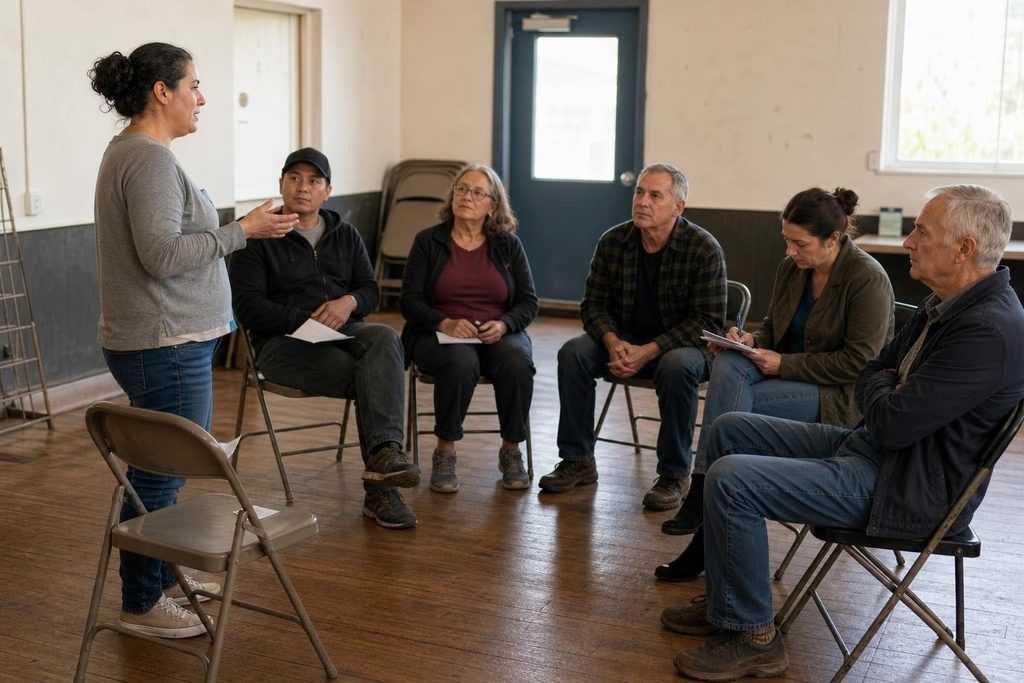
Neighborhood associations, business improvement districts, and chambers of commerce offer places to meet people already engaged in local concerns. Presenting an idea through public comment creates an opportunity to hear objections and discover shared priorities. Participation also takes time, including meetings that may compete with work and family responsibilities.
Bring organized support to the decision
Letters of support and guidance from relevant departments can make a request more concrete when it reaches a local council. They show that the organizer has done more than identify a frustration. A council may still request staff research or defer action, so organized support should not be mistaken for guaranteed approval.
- Confirm the responsible department or jurisdiction.
- Discuss the proposal with relevant community groups.
- Gather support and ask about the decision process.
This sequence turns advocacy into a series of answerable questions. Each contact should clarify what is needed next, whether that is permission, additional information, or consideration at a public meeting.
A useful request connects the desired improvement to the people and procedures that can authorize it.
Make public communication useful and accountable
Trust also depends on what happens between decisions. Regular, relevant information gives residents a way to understand public work, while a clear distinction between information and opinion helps them assess what they are receiving.

Build around the actual workflow
During his district director work, Evan Meyer identified gaps in information continuity and the tools available to incoming elected officials. GovTools developed from those operational needs, with an initial newsletter product shaped around local officials’ workflows. The lesson is to understand how work gets done before deciding what technology should change.
Distinguish public information from interpretation
The newsletter model aims to provide impartial community information while allowing an elected official to offer a separately identified personal perspective. That distinction matters because an update and an argument serve different purposes. Regular communication also creates an opportunity to demonstrate follow-through on the subjects residents elected an official to address.
Ask how another viewpoint was formed
Respectful communication requires curiosity about the information behind another person’s position. Instead of treating disagreement as an invitation to win, a useful approach examines the assumptions, sources, and concerns involved. Shared interests, such as family safety, can exist even when people interpret an issue differently.
- Provide information relevant to residents.
- Identify interpretation separately from factual updates.
- Examine the sources behind disagreement.
These practices connect communication with respect rather than volume. Publishing more material is not the same as giving people information they can use or taking their concerns seriously.
For anyone building community trust, the communication task is specific: make public work understandable without requiring agreement on every issue.
Keep progress grounded in people, not just persistence
Long projects create a different leadership problem: deciding what deserves continued effort. Commitment can sustain useful work, but it also needs boundaries, supportive relationships, and a definition of success broader than keeping a venture alive.

Let partnership carry some of the weight
During a difficult early period at Ride Amigos, Evan Meyer considered taking a job and putting the venture on hold. His partnership with a close friend from high school helped sustain the effort. Accountability mattered, but so did enjoying the work and caring about the person sharing it.
Recognize the limits of stubbornness
Persistence can help an organizer withstand delays before support arrives. It can also become a liability when past investment becomes the main reason to continue. The useful distinction is between commitment to solving a problem and an unwillingness to reconsider the particular approach already chosen.
Define success beyond financial accumulation
Financial stability has a place in a sustainable life, but it is not the only measure. Peace of mind, health, family well-being, and meaningful relationships also belong in the assessment. This broader view gives an organizer grounds to question whether pursuing more growth still serves the life the work was meant to support.
- Consider the strength of working relationships.
- Question commitments driven only by past investment.
- Include personal well-being in the definition of success.
These questions do not produce an automatic decision to continue or stop. They make room for judgment beyond the pressure to prove that an earlier choice was right.
Sustaining useful work means protecting the people doing it, not treating their exhaustion as evidence of commitment.
Trust grows through practical commitments
The work of building community trust connects respect with delivery. An idea becomes more credible when people can understand it, participate in it, and see that commitments lead to action.
The first lesson is to begin with a specific, manageable improvement. Permission, relevant skills, and a clear scope give an early supporter something concrete to approve and an organizer something realistic to complete.
The second is to learn the local process rather than push against an imagined one. Responsible departments, community groups, and decision-makers each have a role that becomes clearer through direct contact.
The third is to make communication useful and respectful. Relevant updates, visible distinctions between information and opinion, and curiosity about disagreement provide a stronger basis for participation than persuasion alone.
For an unresolved workplace or neighborhood concern, a practical next move is to define one achievable change and identify the first person to contact. Progress can begin there, with a commitment small enough to honor and relationships strong enough to support it.
Frequently asked questions
What is a practical first step in building community trust?
Choose one specific problem, identify who can authorize action, and make a commitment that can realistically be completed.
How can residents raise a local problem?
Contact the responsible office, discuss the idea with relevant community groups, and ask how the proposal can reach the appropriate decision-maker.
Why separate public information from an official’s opinion?
Separating them helps residents distinguish community updates from an official’s interpretation and assess each on its own terms.
When should an organizer reconsider persistence?
Reassessment is useful when past investment becomes the main reason to continue, especially if the approach no longer serves the problem or personal well-being.