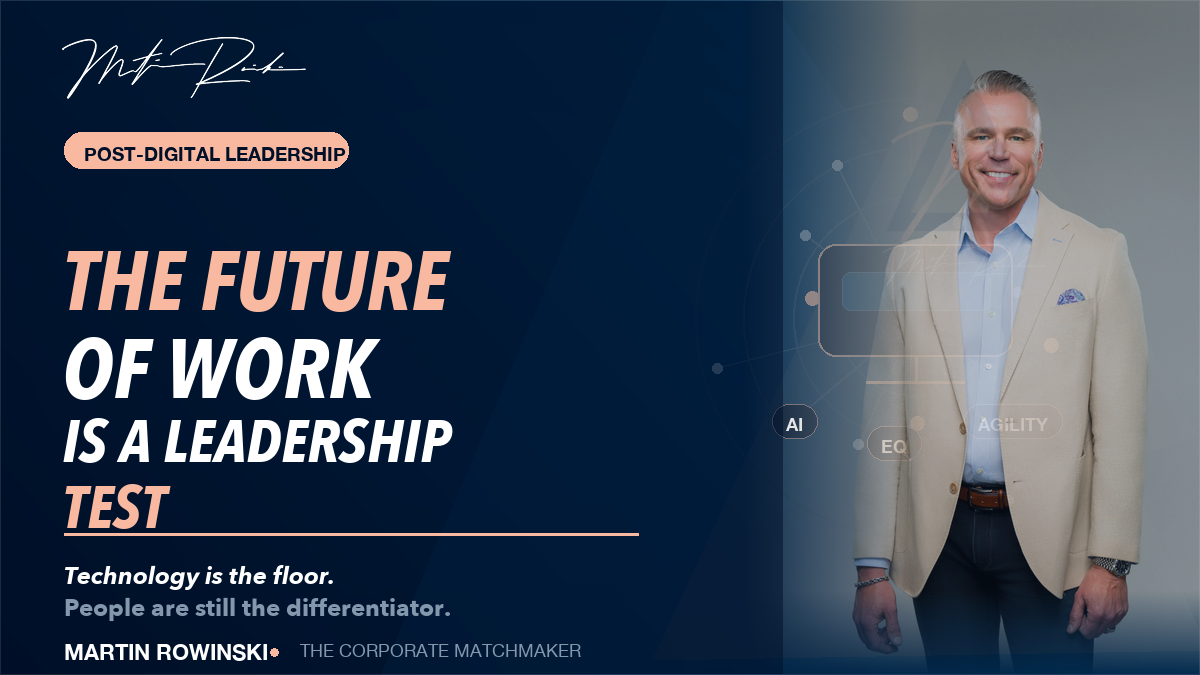
The future of work is not coming.
It is already here.
For years, companies talked about digital transformation like it was a future project. Something to plan for. Something to budget for. Something to eventually get around to.
That time is over.
We are now in a world where digital is no longer the differentiator. It is the starting point. Technology is expected. AI is becoming part of daily operations. Remote and hybrid work are normal. Teams are global. Customers move faster. Markets shift faster. And leaders are being asked to make decisions with more complexity than ever before.
But here is what I believe: the future of work will not be won by technology alone.
It will be won by leaders who know how to combine technology with people, values, emotional intelligence, adaptability, and action.
That is the real leadership test.
Digital Is The Floor, Not The Finish Line
There was a time when having the best technology gave a company an edge.
Today, technology is the floor.
Almost every company has access to tools that can automate work, analyze data, improve communication, and help teams move faster. The tools are important, but they are no longer enough by themselves.
The question is not just, “Do we have the technology?”
The better question is, “Do we have the leadership to use it well?”
That is where many companies will separate themselves.
Some leaders will chase every new tool without a clear strategy. Others will resist change because it feels uncomfortable. The strongest leaders will do something different. They will connect technology to the mission of the business, the needs of the team, and the value they are trying to create for customers.
Technology should support values, vision, mission, relationships, and action.
If it does not, it becomes noise.
Emotional Intelligence Is Not Optional
As work becomes more digital, human leadership becomes more important.
That may sound simple, but it is easy to forget.
People are not machines. They are navigating change, pressure, uncertainty, family responsibilities, career goals, personal challenges, and constant information overload. Leaders who ignore the human side of work will struggle, no matter how advanced their systems are.
Emotional intelligence is no longer a soft skill.
It is a leadership requirement.
The best leaders know how to listen. They know how to read the room, even if the room is virtual. They know how to build trust, manage stress, communicate clearly, and create an environment where people feel valued.
In a post-digital world, leaders have to be both strategic and human.
You can have the best AI tools in the world, but if your team does not trust you, if communication is poor, or if people feel disconnected from the mission, the technology will not save you.
Agility Has To Become Part Of The Culture
Change used to come in waves.
Now it feels constant.
New tools. New competitors. New customer expectations. New regulations. New ways of working. New pressure on teams to do more with less.
This means agility cannot sit in a strategy document. It has to become part of the culture.
Leaders must be willing to pivot, but not panic. They must move fast, but not blindly. They must ask better questions, bring the right people to the table, and make decisions with both speed and discipline.
Agility is not chaos.
Agility is the ability to stay grounded while adjusting to reality.
That takes communication. It takes trust. It takes humility. It takes leaders who are willing to admit when something is not working and take action before the problem gets bigger.
The companies that thrive will not be the ones that avoid change. They will be the ones that build teams capable of learning, adapting, and moving forward together.
Innovation Is Everyone’s Responsibility
Innovation cannot be locked inside one department.
It has to live inside the culture.
That does not mean every idea will work. It does not mean every risk will pay off. It does mean leaders have to create an environment where people can think, challenge, test, learn, and improve.
One of the biggest mistakes leaders make is punishing failure while asking for innovation.
You cannot have it both ways.
If people are afraid to bring ideas forward, the company loses. If they are afraid to question old processes, the company slows down. If they are afraid to learn from mistakes, the company repeats them.
Strong leaders create room for smart risk.
They also create accountability.
Innovation does not mean doing random things and hoping something works. It means connecting creativity to strategy, customer needs, and measurable outcomes.
That is how innovation becomes leadership, not just activity.
AI Should Help Leaders Make Better Decisions
AI is changing the workplace quickly.
It can help leaders analyze information, automate repetitive work, identify patterns, improve customer experience, and make better decisions faster.
But AI should not replace leadership judgment.
It should support it.
Leaders need to understand where AI is being used, what data it relies on, what risks are involved, and where human oversight is still required. This is especially important for executives and boards.
You do not need to become a machine learning engineer to lead in the AI era, but you do need to ask better questions.
Where does AI improve decision-making?
Where could it create bias?
Where does the company still need human judgment?
Who is accountable when something goes wrong?
How does this technology align with our values and mission?
The future of work will require leaders who are tech-savvy, but also responsible. Speed matters, but trust matters more.
Automation Should Elevate People, Not Erase Them
Automation will continue to change jobs.
Some tasks will disappear. Some roles will evolve. New opportunities will be created. That reality can create fear inside organizations if leaders do not communicate clearly.
The goal should not be to replace people with technology as quickly as possible.
The goal should be to use technology to help people do more meaningful, valuable, and strategic work.
That requires planning. It requires training. It requires honest communication. It requires leaders to think about the future skills their teams will need, not just the tasks that can be automated today.
If leaders want trust during transformation, they have to bring people into the conversation.
Do not leave your team guessing.
Tell them where the company is going. Tell them why change is happening. Tell them how they can grow with it.
People can handle change better when they understand the purpose behind it.
The Future Of Work Is Also About Legacy
I talk a lot about legacy because leadership should be bigger than the title.
The way leaders respond to this moment will shape more than quarterly results. It will shape cultures, careers, customer trust, and the future of organizations.
In a connected world, leadership is more visible than ever. People can see how companies treat employees. They can see whether leaders act with integrity. They can see whether a company is serious about sustainability, ethics, inclusion, and long-term impact.
That matters.
Building a successful company is important. Building a company people respect is even more powerful.
The leaders who stand out in the future of work will be the ones who understand that growth and responsibility have to move together.
They will build around values.
They will use technology wisely.
They will develop people.
They will communicate with honesty.
They will create cultures that can adapt without losing who they are.
That is how legacy is built.
What Leaders Can Do Now
The future of work can feel overwhelming, but leaders do not need to have every answer today.
They need to start asking the right questions and taking the right actions.
Here are a few places to begin:
- Keep learning. Stay close to technology, market changes, AI, and leadership trends.
- Invest in emotional intelligence. Listen better, communicate clearly, and build trust.
- Develop adaptable teams. Reward learning, problem-solving, and thoughtful action.
- Use AI with accountability. Do not adopt technology without understanding the risks.
- Make innovation part of the culture. Encourage ideas, but connect them to strategy.
- Lead with purpose. Make sure growth aligns with values, people, and long-term impact.
- Bring the right people to the table. Advisors, board members, mentors, and trusted voices can help leaders see what they cannot see alone.
You do not have to build the future alone.
But you do have to lead with intention.
Final Thought
The future of work is not just about technology.
It is about leadership.
Technology will keep changing. AI will keep advancing. Markets will keep shifting. The tools will get faster, smarter, and more powerful.
But people will still need clarity.
They will still need trust.
They will still need purpose.
They will still need leaders who communicate, adapt, listen, and take action.
The post-digital era will not reward leaders who simply chase tools.
It will reward leaders who know how to use those tools to build stronger teams, better decisions, meaningful relationships, and a legacy that lasts.
That is the work ahead.
And that is the opportunity.