
Leadership is the capacity to effectively lead, inspire, and steer individuals or collectives towards a shared objective. Empowerment is an essential competency for leaders, as it allows them to grant their team members the power and resources to independently make decisions and take action.
Empowerment encompasses various strategies, including task delegation, offering training and growth prospects, and granting team members the freedom to make decisions within their assigned domains. Through the act of empowering employees, leaders have the ability to fully utilize the capabilities and talents of their team, resulting in a workforce that is more involved and efficient.
Nevertheless, it is crucial to acknowledge that empowerment is not a singular, isolated event. Ensuring the success of team members necessitates a continuous commitment and regular communication to provide them with the essential resources, support, and advice. In addition, competent leaders must possess the capacity to strike a balance between empowering their team members and ensuring accountability and monitoring.
To summarize, the act of empowering employees is a crucial leadership ability that allows team members to assume responsibility for their tasks and exercise autonomy in decision-making. This can result in heightened productivity, engagement, and job satisfaction. Nevertheless, achieving accomplishment necessitates unwavering dedication and proficient interaction.
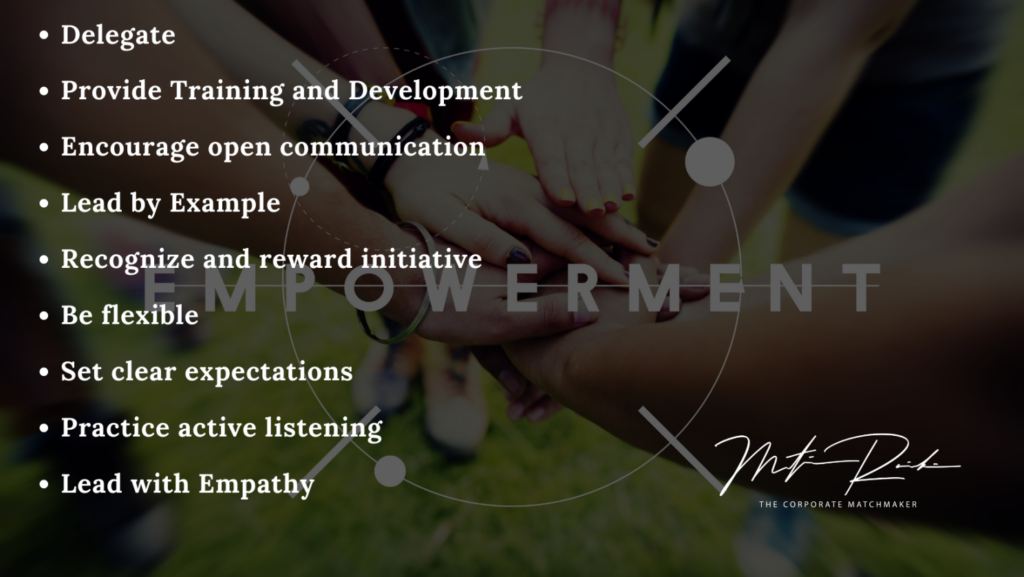
Here are several strategies for cultivating the talent of empowerment as a leader:
- Assign duties and responsibilities to team members, initially providing them with clear instructions, and progressively granting them more independence as they prove their competence in handling more responsibilities.
- Offer educational and growth prospects: Enhance your team’s growth and progress by allocating resources towards training and educational experiences. This may encompass workshops, mentoring, and coaching programs.
- Promote and foster transparent and unrestricted exchange of information: Establish a conducive atmosphere that fosters team members’ willingness to openly express their thoughts and address any problems they may have. Promote feedback and attentively listen to the input of your team.
- Set a precedent by your actions: Demonstrate leadership by proactively taking action and demonstrating your confidence in your team’s ability to make decisions.
- Acknowledge and incentivize initiative: Acknowledge and incentivize team members who demonstrate proactive behavior and exercise autonomy in decision-making. This will serve as an incentive for others to replicate the same behavior.
- Adapt and adjust: Embrace novel concepts and demonstrate a willingness to modify your leadership approach in order to cater to the requirements of your team.
- Establish unambiguous standards: Effectively convey the objectives and anticipated outcomes for your team and guarantee that they are equipped with the essential resources and assistance to accomplish them.
- Engage in active listening: Maintain receptiveness to input and actively engage in attentive listening with your team. This will enable you to comprehend the requirements for success and adjust your leadership strategy accordingly.
- Place confidence in your team: Have faith in your team’s ability to make decisions and carry out tasks. This will enhance their self-assurance and foster a greater sense of ownership over their work.
Demonstrate empathy as a leader by actively acknowledging and comprehending the difficulties and hardships faced by your team members, and consistently providing them with assistance.
It is important to remember that cultivating the ability to empower oneself requires a significant amount of time and regular dedication. It is an ongoing journey of personal development and enhancement.