

Self-confidence is the conviction in one’s own capabilities, attributes, and discernment. An crucial attribute for leaders is the ability to make decisions with certainty, effectively communicate with their team, and instill confidence in others. Lack of self-assurance can hinder leaders’ ability to lead and make decisions, so adversely affecting their team and the overall success of the organization.
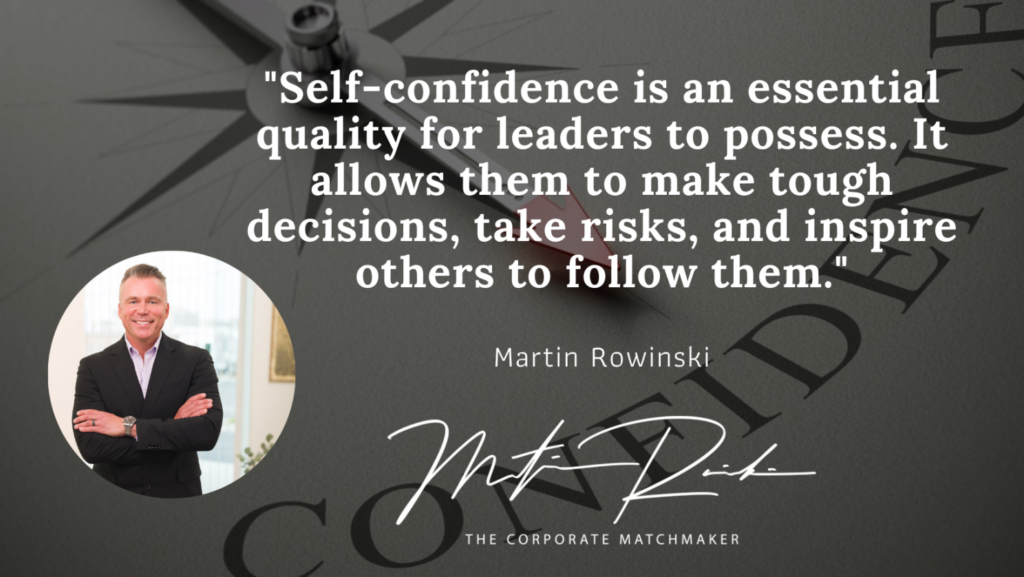
Leaders must possess self-confidence as a crucial attribute. It enables individuals to make difficult choices, embrace uncertainty, and motivate others to emulate their actions. Lacking self-assurance, leaders may have hesitation in their decisions and lack the necessary certainty to effectively lead their team.
 Leaders can cultivate and sustain self-confidence through many methods. Leaders can enhance their self-confidence by establishing unambiguous and attainable objectives. Establishing objectives enables leaders to concentrate their energy and endeavors, and offers a clear feeling of direction and purpose. Leaders who establish and accomplish their objectives cultivate self-assurance in their own capabilities and enhance their drive to persistently pursue triumph. In addition, establishing objectives enables leaders to assess their advancement and commemorate their accomplishments, which can further enhance their self-assurance. Leaders must prioritize realism and specificity when establishing goals, and they should also divide larger objectives into smaller, more feasible tasks. This aids in guaranteeing that objectives are achievable and that advancement is being produced regularly. Leaders can enhance their efficacy in their roles by establishing and attaining their objectives, hence cultivating self-assurance.
One might enhance their self-confidence by actively pursuing novel challenges and possibilities for learning. Leaders can enhance their skill set and expand their outlook, so bolstering their self-assurance in their capabilities.
Leaders should actively seek to surround themselves with individuals who are helpful and encouraging. This can encompass individuals such as colleagues, mentors, and friends who can provide valuable input and support to assist leaders maintain their concentration and drive.
Self-confidence is significantly influenced by effective communication. Leaders that possess the ability to articulate their thoughts and goals with clarity and confidence are more inclined to inspire and encourage their team.
 Efficient communication is an essential element of self-assurance as it enables leaders to effectively articulate their thoughts, concepts, and objectives to their team. Effective communication by a leader showcases their self-assurance in their own skills and the team’s chosen path. Consequently, this can instill assurance in others and result in more efficient and triumphant results.
Active listening is an additional method to enhance communication skills and cultivate self-assurance. This is diligently attending to the words and ideas expressed by others, inquiring for further clarification, and actively striving to comprehend their point of view. By engaging in this practice, leaders can enhance their comprehension of the requirements and apprehensions of their team and showcase their dedication to cooperation and transparent communication.
In summary, possessing self-assurance in leadership is crucial for instilling confidence and drive in others, as well as for proficiently steering a team towards achievement. Leaders can enhance their self-assurance and foster a constructive and efficient work atmosphere by establishing objectives, enhancing their communication abilities, and attentively listening to others.
In the end, self-confidence cannot be acquired instantaneously. Developing and maintaining it necessitates unwavering dedication and regular practice. Nevertheless, the advantages of self-confidence for leaders are incalculable, as it empowers them to motivate and direct their team with unwavering belief and resolute purpose.